

GROWING THE FUTURE TOGETHER
The 2022 AMGA conference
By Dr Jenny Ekman
At the end of October, the mushroom industry will meet in Adelaide for the first industry conference in several years. With a diverse speaker program, the conference provides a unique opportunity to learn about new advances in research, farm practice and marketing initiatives, as well as offering great networking opportunities.
This year, the AMGA conference will host suppliers, growers, farm owners and well-respected national and international speakers.
Following farm tours on day one, day two of the conference (Thursday 27 October) is dedicated to
international speakers. A wide range of presentations will focus on topics critical to the ongoing sustainability of the industry, including harvest mechanisation, new variety development and alternative casing materials.
One of the great range of international guests are profiled below.
Picking the best from harvest practices
Mushrooms are already a technology-intense crop. More than any other, they rely on precise control of
substrate, climate, nutrition, and irrigation. Many aspects have been mechanised, with computer controlled compost production, bulk phase 3 compost, automatic casers and fillers and many other technological aids.

However, the most important part of cropping – harvest – is still entirely done by hand. Many growers were already struggling with rising labour costs before COVID-19.
In recent months, the difficult situation resulting from numerous unfilled positions has been exasperated by illness-derived labour shortages. Added to the major cost of labour to growers is now the almost daily worry of worker availability.
For more than 30 years engineers have been trying to develop a robotic mushroom harvester. This is no easy task. Mushrooms need to be picked gently, trimmed appropriately, and placed into grades according to size and shape. A firm touch or sharp edge can easily disfigure or bruise mushrooms. Furthermore, as mushrooms are not regularly spaced on the beds, picking single mushrooms from clustered groups poses another special challenge.
Initial robotic harvester designs had limited success. Silsoe Research Institute developed an early robotic harvester in 19931. A suction cap attached to each mushroom, which then twisted and lifted the mushroom. While it could locate 84% of mushroom targets, only 57% were picked successfully. Overlapped or closely packed mushrooms were the most difficult to pick.
Technology has come a long way since the 1990s, and so has the search for robotic mushroom harvesting. A quick Google search reveals at least 10 companies (and universities) involved in developing commercial harvest technology for mushroom farms.
Any such technology is inevitably going to be capital-intensive. A potentially less expensive approach is to develop ways to increase efficiency of human pickers. This may mean using single layer beds, or moveable and/or tilting trays.
One company working on both options is GTL Europe. The company was initially formed in 1994 by Jack Lemmen as a tiny start-up in a shed beside his parents’ house. In 2013 he merged with three companies: Geraedts, Thilot and Lemmen. This has given the larger group expertise in air handling and control, composting and growing equipment, and waste management.
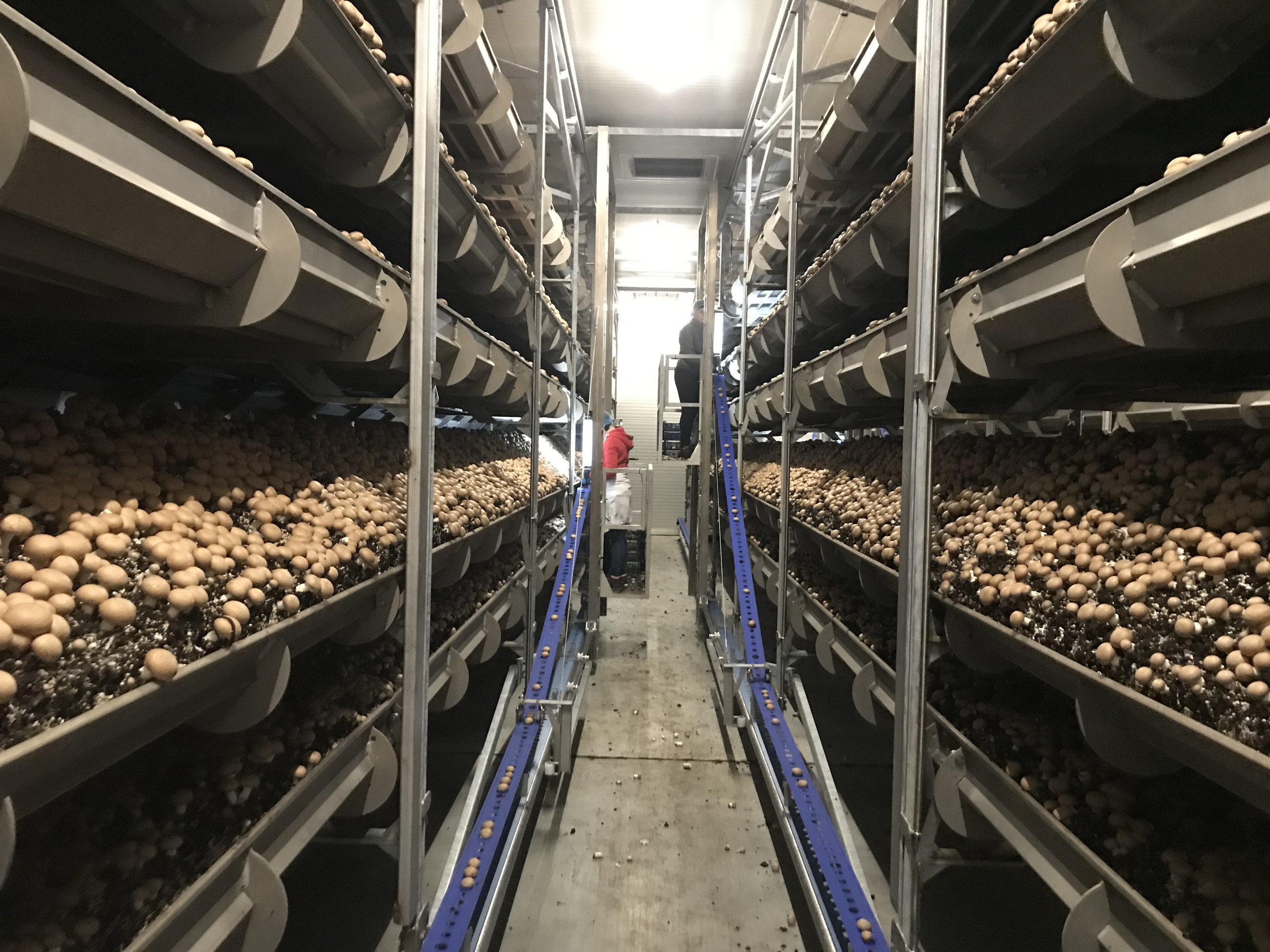
GTL Europe is now a globally recognised company involved in all levels of mushroom cultivation. It offers solutions to compost producers and farms including construction design, climate control systems, machinery, and automation solutions.
Jack Lemmen will be presenting at the 2022 AMGA conference on some of the latest developments in automation on mushroom farms. According to Jack, “The tilting shelves system was just the beginning. It is really the starting point towards a fully integrated harvesting system. Technological developments such as robotics and artificial intelligence are creating an array of opportunities to further optimise the harvesting process.”
Huge improvements have been made in scanning, grading, and packing equipment for many fresh horticultural industries. Perhaps it is time for a great leap forward for mushrooms. Jack is certainly well qualified to give insight into what new technologies are becoming available, and potential benefits for the mushroom industry. It is certain to be a fascinating subject.
This is an excerpt for the MushroomLink Spring 2022 magazine, click here to read the full article and publication

The Industry testing program: Rebooted!
Written By: Dr Jenny Ekman
TESTING TO PROVE, OR TESTING TO IMPROVE?
Among the seemingly endless list of compliance requirements that all fresh produce businesses face, verification testing is often questioned from both a cost and value perspective. “Why do we have to test” is a common question, and for most, the answer would be “because our customers say we have to”. While the answer is not wrong, the driver for compliance is misguided.
Anyone in the business of growing and supplying food to consumers understands that consumers trust the food they buy is safe and rely on the integrity of both process and product.
The seemingly endless range of testing for heavy metals, chemical residues and microbial contamination won’t itself make the product safer. However, it will provide assurance and surety that the processes followed deliver a product that is free from residues and safe to eat, factors that are critically important at a business, industry and ultimately customer level.
The Testing Program
For some years now, the Australian Mushroom Growers’ Association (AMGA) has organised competitively priced testing of fresh mushrooms and inputs (water, compost) for members. The testing commenced in the early 2000s, with the program including all the microbial, chemical residue and heavy metal tests required by food safety certification programs.
As well as providing keen pricing, the advantage of using the industry program is that all test results are reviewed and reported back accompanied by an explanation of what they mean. In other words, whether any of the results raised concerns and what should happen next if they did.
The de-identified results gathered through the program over the last 15 years are also a valuable resource for the industry as a whole. For example, from 186 tests of fresh mushrooms in the previous five years, there has been only a single detection of E. coli (which was <100 CFU/g), no detections of Salmonella spp. and no detections of Listeria monocytogenes.
Such data provides objective, defensible evidence that growers are following good practices and mushrooms are safe to eat.
Until now, the on-request testing procedure was that growers downloaded a form from the AMGA website, filled it in and sent it back to the Association. A request would then be made for a test kit to be sent to the grower from the lab. The grower took the samples, filled in the analysis request form, and returned it to the lab for testing. While this has worked well enough, it certainly added unnecessary steps in the process, an extra layer of complexity and, therefore, an opportunity for error.
Now, with the support of levy-funded project MU20000 - Extension and Adoption for Food Safety, Quality and Risk Management, every mushroom business can conduct one full suite of chemical and microbial tests each year – for FREE.
The testing on fresh mushrooms includes chemical residues (CR006), heavy metals (ESM-02) and microbial contamination (E. coli, Salmonella spp and L. monocytogenes). The program also includes a water test for E. coli (CFU/100ml).
This industry-wide service is designed to encourage verification testing to support individual businesses. It will also strengthen the pool of de-identified test data available, helping identify and manage potential risks.
The Process
Simply email your request to the Food Safety (FS) project team, and the kit will arrive in the mail accompanied by instructions, a pre-filled analysis request form and a return pre-paid satchel.
This new system also means that absolute confidentiality is ensured regarding the results. Only the FS project team will know which grower code links to which individual farm.
Again, results will be accompanied by an interpretation of what they mean. For efficiency, testing through this program will be available three times a year. The first round of free testing will commence at the start of April. The following testing rounds will be in August and December.
Email Dr Jenny Ekman to receive your FREE chemical, microbial and heavy metal test kit, helping the industry demonstrate the high standards of Australian mushrooms and providing you with the data you need for an audit.
The current testing program arrangements will continue for those businesses who need to test other inputs or test more frequently. This will now follow the new and improved administrative process.
An updated cost schedule will be available on request.
Lessons from chemical and heavy metal testing
Just like forensic investigators on TV, chemical residue or heavy metal test results can provide vital information on inputs such as compost and compost ingredients, supplements and chemicals.
When residues are detected, they are usually well below the maximum residue level (MRL). However, when there are detections, it is worth considering at what percentage of the MRL they are and reviewing factors such as inputs, use patterns and application rates. this approach ensures total control of products and processes, in the most cost-effective way.
Lessons from microbial testing
Close monitoring of microbial test results can often pre-empt an issue before it becomes a problem. Indicator organisms detected at low levels in products or inputs can help identify issues with infrastructure, cleaning and hygiene practices.
A problem understood is a problem solved, and testing produces the opportunity for this understanding
This article was originally published in the 1st issue 2022 edition of the Australian Mushrooms Journal

Reset and Refresh – towards better collaboration between Hort Innovation and industry
In mid-last year, the Seftons review was commissioned to examine the working relationships between industry peak industry bodies (PIBs) and Hort Innovation. The review identified a number of issues, particularly relating to governance and communication.
As a result, a working group was established consisting of representatives from the PIBs, the Hort Innovation board and the Commonwealth government. The working group has been developing a new framework for collaboration between industry and HIA.
On 14 and 15 June mushroom industry representatives Geoff Martin, Nick Femia and Leah Bramich took part in two “Reset and Refresh – Roles, responsibilities and advice mechanisms” industry workshops. The aim was to find ways to work together better, particularly in terms of developing advice mechanisms for both research and development and marketing and promotion.
Discussion was constructive and focussed on raising the quality of outcomes for all industry participants. Hort Innovation has committed to communicating clearly and regularly with industry and is currently considering how best to act based on industry feedback. The outcome should be maximised returns on investment for all levy payers.
According to AMGA General Manager Leah Bramich “This was an extremely important and positive first meeting, with Hort Innovation and industry working together collaboratively and transparently. I am really pleased to see this important first step towards meaningful change and a better future”.
Access the HIA report on this initiative or download the DAWE Best Practice Guide to Stakeholder Consultation.

New look mushroom marketing strategy built on collaboration
The team at HIA have developed a new approach to the Marketing Planning Process, through close collaboration with industry.
The fresh approach, presented in September by HIA General Manager Jane Smith, laid out a commitment to foster better working relationships with growers and their peak industry bodies.
Included in the plan are workshops with industry and the AMGA, farm visits, as well as ongoing consultation with the SIAP
The collaborative workshops will provide an opportunity to share ideas and discuss recent developments. Results from these events will shape activities for the 2023 financial year.
Concurrently, and responding to feedback from growers, the Hort Innovation Australia (HIA) Mushroom marketing team, Head of Consumer Marketing Gillian Reilly and Marketing Manager, Emma Day have been busy refocusing their marketing strategy.
Through leveraging current diet trends, there are ample opportunities for mushrooms in the vegan, vegetarian, flexitarian, meat-reducing, plant-forward, superfood and sustainability spaces.
Riding on new consumer data that Australian eating habits post-COVID are leaning towards more home cooking, less meat and with a greater focus on nutrition, the new brand strategy is focused on pitching mushrooms as an everyday, for everyone, essential ingredient
Guiding the new strategy is a four-pillar approach designed to unlock the core challenge: How do we inspire consumers to consider and use mushrooms more often?
Top of mind awareness is the first pillar and seeks to increase prominence of mushrooms through media and communication activities. In practice, this means positioning Australian mushrooms as an essential ingredient in everyday meals to improve taste and nutrition. A highly successful campaign with celebrity Chef Adam Liaw at the Mushroom Meatery is a great example of this initiative in action.
Promoting the nutrition and unique health benefits of mushrooms by educating and inspiring to incorporate mushrooms in home cooking consumers forms pillar two. The consumer claims research run by Fiftyfive5 is a great example of this initiative in action. Consumers were asked to rank a variety of mushroom health claims against criteria of appeal, credibility & uniqueness. The results have been summarised in a handy grower fact sheet, which can be accessed www.australianmushrooms.com.au in the new Industry Portal section.
Increasing the visibility of mushrooms in retail settings to capitalise on impulse buying is the basis of pillar 3. Activities here include inspiring shoppers to purchase mushrooms via in-store inspiration mechanics i.e. product demonstrations and sampling, retail out of home advertising panels close to or inside of stores, and retailer in-store and online advertising.
Weaving mushrooms into café culture, and Australia’s beloved brunch, is an exciting project and the fourth pillar of the brand strategy. Mushrooms are in a position to follow in the wake of smashed avocado on toast and become a must-have menu item. The AMGA-run project has developed and is executing this “ Foodservice Program” work with cafes.
Look out for further updates on the new brand strategy in the quarterly Mushroom Link magazine.

New Mushroom Levy R&D investments a win for the industry
The Mushroom Strategic Investment Advisory Panel (SIAP) has confirmed its advice on recommendations to Hort Innovation for the 22/23 financial year.
In a resounding success for mushroom growers, the SIAP supported all ten of the proposed research and development levy funded projects at their May meeting.
This 100% support rate demonstrates the strength achieved through determined collaboration. Hort Innovation have worked closely with the AMGA, growers, and industry stakeholders to ensure the best possible outcome for the industry.
Activities included a joint industry workshop between Marsh Lawson Mushroom Research Committee (MLMRC), AMGA, SIAP and Hort Innovation in December 2021 to itemise the industries high level priorities with alignment to the Mushroom Strategic Investment Plan (SIP) 2022-2026.
Dr Geoff Martin, AMGA Chairman, says this result sends a strong signal of the value of research in the industry. He is particularly enthusiastic about two projects, both of which are real investments in the long-term sustainability of Australian mushroom growing.
“Investing in the sustainable transition away from European sourced peat will advance mushroom farming in Australia and protect it from geopolitical upheavals elsewhere”, Dr Martin said.
“Currently we import all our peat, which makes the industry vulnerable to supply chain issues out of our control.”
Also approved in this round is a commitment to training a new generation of mushroom pathology experts and building expertise and scientific capacity in Australia around mushroom viruses.
Science and research not only provide the innovations required to evolve mushroom growing in a sustainable manner, it is also critical in protecting the industry from disruptions caused by diseases.
“We have a great opportunity to collaborate with Australian universities and the international community, for example Dr Helen Grogan from Tegasc (The Irish Agriculture and Food Development Authority) in Dublin, to support a PhD project in mushroom virology, which is especially significant given the recent finding of a possible unique virus X expression in Australia”, Dr Martin said.
“Now more than ever we understand the potential disruption caused by novel viruses. It is vital we maintain expertise to fight any future threats to the industry”.
Other highlights include strategic long-term investments focussing on promoting the health and nutritional benefits of Australian mushrooms.
AMGA Relationship and General Manager Leah Bramich, says these projects will go a long way to cement Australian mushrooms as a healthy, unique, and vital part of the Australian diet.
“Firstly, we are looking to influence a change to the Australian Dietary Guidelines, for mushrooms to be listed as a separate food group. This opportunity only comes round once every 8-years and is paramount to highlighting the uniqueness of mushrooms to both consumers and the health sector.”
“We are also funding a study focussing on the viability of pursuing a health claim for vitamin D, which, coupled with the current CSIRO beta-glucan study, will be very powerful positioning in the health space, and if the claims are successful, will create huge market potential for mushrooms.”
“These new investments and the (completed) Educating Health Professions and (current) Educating Food service projects will all feed into a new multi-year communications program, including a ‘mushrooms for health’ style website, focusing on long term education for health professionals”.
Grower communication and education has not been forgotten in the new investment recommendations, with two new initiatives; a 5-year plan for the Australian Mushroom Industry Conference, which includes bi-annual roadshow, as well as international outbound and inbound study tours open to growers, both of which will facilitate the exchange of ideas among the global mushroom growing community.
“These programs are designed not to fund grower travel directly, but to facilitate educational opportunities for growers, with tours and experiences they wouldn’t ordinarily be able to coordinate. The inbound and outbound study tours will be particularly exciting and highly beneficial for grower levy-payers”.
Updates on all projects will be reported in upcoming issues of Mushroom Link Magazine.
If you want to know more about these or any other Mushroom levy investment, you can talk directly with the Hort Innovation Mushroom Industry Strategic Partner. Mark Spees P: 0439 574 173 @: Mark.Spees@horticulture.com.au
For any media distribution of this information please contact communications@horticulture.com.au
The ten investments:
-
The SIAP supported this investment recommendation acknowledging it as a high priority strategic investment for the industry. They recommend a staged approach with stop-go milestones utilising a project reference group (PRG) of experts (local and international) at the evaluation stages of the project. The Request For Proposal (RFP) will be informed by a funded symposium of international experts, ideally at the 2022 National Mushroom Industry Conference.
Strategic Background: Peat is a key component of professional horticulture, used in the production of mushrooms and nursery along with several other industries, due to its favourable physical, chemical, and biological characteristics. It also has a long history as a fuel source with peatlands (bogs) being mined for centuries. With increasing awareness that damaged peatlands are a large source of greenhouse gas emissions (calculated at nearly 5% of global anthropogenic CO2 emissions), many countries previously relying on peat production as an industry have now move towards peatland conservation and restoration to meet their commitments to international agreements, including the Paris Agreement on climate change. In 2020, Australia imported $16.7M of peat, which represented 1% of global imports (https://oec.world/en/profile/hs/pea), noting that a large proportion of this supplies the mushroom industry. Over the past 18 months, the price of peat has doubled with higher freight costs, increased competition to access peat, and restrictions to supply, leading to an ever-increasing need to source alternate casing substrates. This requires research which builds on the previous studies of substrates, investigating new options to evaluate or develop alternatives which not only provide mushroom growers with a sustainable and affordable resource, but integral is that an alternative consistently provides equivalent (or improved) production in terms of yield and quality.
As Ireland has begun to decommission peatbogs and deep peat extraction (completed by 2035), and Germany/Western Europe beginning to follow this approach (Eastern Europe still offers supply, but unsure of the timeframes in the long term for worldwide supply), peat will become more expensive, increasing cost of production.
The Irish Government has supported a $1.65M Euro project (Beyond Peat and Sustainable Transition) to work on alternate casing substrate. There is value to link with global innovators in this research space to ensure that Australia has viable options and does not duplicate the effort.
This research is a long-term investment to secure an alternative option, before access to peat is lost. This research will allow for the mushroom industry to diversify, to further explore and develop a new substrate and potentially begin to transition to the new option in a phased approach while peat is still available.
-
The SIAP supported this investment to assess packaging options that are economically viable and acceptable to retailers and consumers in the Australia context.
Strategic background: There is increasing conversation and push for sustainable packaging in the Australian food supply chain. PET is currently the dominant packaging material and while this is recyclable via kerbside collection, packaging targets and retailer customer charters were signalling that increased sustainability would be necessary. The use of single use soft plastics (PVC wrap) and hard plastics that are not derived mainly from recycled content are going to be under increased pressure to be phased out.
-
The SIAP strongly supported this investment.
Strategic background: The Australian Dietary Guidelines is a resource to help Australians to make healthy food choices based on scientifically based nutrition and health information (National Health and Medical Research Centre 2013). The guidelines aim to provide this information to maximise health options and mitigate disease and illness due to poor nutritional choices in the Australian population. A series of companion resources accompany the guidelines to further enable all Australians to access and implement the information.
The Australian Dietary Guidelines are summarised in the form of the Australian Guide to Healthy Eating, which pictorially depicts the separation of food groups and the associated daily or weekly consumption quantity. The food groups are:
Grain (cereal) foods, mostly wholegrain and/or high cereal fiber vegetables
Vegetables and legumes/beans
Lean meats and poultry, fish, eggs, tofu, nuts and seeds and legumes/beans
Fruit
Milk yoghurt, cheese and/or alternatives, mostly reduced fats
There is compelling evidence to suggest that fungi (mushrooms) should be a separate food group in the Australian Dietary Guidelines and that this separation would help to drive consumption by highlighting the specific health and nutritional benefits of mushrooms as distinct from their current vegetable grouping.
-
The SIAP supported this strategic long-term investment, focussing on health care professionals as the target audience.
Strategic background: The aim of this project is to systematically collate scientific information and to form an institute for mushroom nutrition, health, and wellness information. The investment is inspired by the Olive Wellness Institute, and the Nuts for Life Program that are backed by science, promote benefits to health care and food service professionals, are supported by a scientific committee, have developed an online resource platform that collates scientific information to produce webinars and attend conferences. Each is underpinned by a systematic literature review and has challenged misconceptions about the health benefits of the respective products. There has been a significant volume of scientifically based research produced, not only through the Mushroom Strategic Levy funded projects, but also international industry and health and nutrition research institutes/universities.
-
The SIAP supported this investment, acknowledging that it is important to understand the sustainability position of the industry and underlaying businesses. It will be an important deliverable to develop a tool that can be used at the individual business level to measure sustainability performance.
Strategic background: The Australian mushroom industry has undertaken projects to understand the limitations and risks with regards to environmental constraints and preparedness in climate change. Following on from this, there is an opportunity to provide an updated life cycle assessment (LCA) to review against previously benchmarked data from 2011, to increase mushroom grower’s awareness of how their business and/or industry is performing, track grower uptake on previous recommendations, highlight where improvements have been made and what further research and development is needed to reduce environmental impacts into the future.
Life Cycle Assessment (LCA) is a systematic analysis for the range of environmental impacts over the course of the entire life cycle of a product, material, process, or other measurable activity. LCA models the environmental implications of the many interacting systems that make up production.
LCA assesses the environmental aspects and potential impacts of a product, process, or service by:
Compiling an inventory of relevant energy and material inputs and environmental releases
Evaluating the potential environmental impacts of those inputs and releases, and
Interpreting the results to better inform decision-makers
An LCA is delivered through four key stages:
Goal and scope - to define how big a part of product life cycle will be taken in assessment and to what end that assessment will be serving
Inventory analysis - to provide a description of material and energy flows within the product system and the interaction with environment, consumed raw materials, and emissions to the environment.
Impact assessment - of the indicator results of all impact categories
Interpretation of a life cycle - this involves critical review, determination of data sensitivity, and result presentation.
-
The SIAP supported this investment pending any regulatory limitations to display prices and ensure there is interest from the retailers.
Strategic background: The investment is to understand what the impact on Mushroom volumes would be if price in retailers were displayed as a per 500g or per 100g basis rather than a per KG basis. Due to the relatively higher price per KG of mushrooms, there is a perception among the industry that this price is an inhibitor to:
Non-category buyers i.e. people who do not engage in the category due to the high price point
Existing buyers purchasing more
NielsenIQ Homescan data shows that the average volume purchased by households per trip is 330g so by displaying the price per KG it is interfering. We have heard anecdotal evidence from sellers that once they changed their display price to per 500g, sales significantly increased.
-
The SIAP supported this investment.
Strategic background: Vitamin D is an at-risk nutrient in the Australian population and mushrooms, particularly when UV-exposed, can be a valuable source of this vitamin. Most foods containing vitamin D are from animal sources and their vitamin D is in the form of cholecalciferol (vitamin D3). Mushrooms are unique, as they are a non-animal source of vitamin D, and it is in the form of ergocalciferol (vitamin D2). To substantiate any nutrient or health claim for vitamin D, there must be a minimum of 10% of the regulatory RDI (recommended daily intake) in a serve of food. Schedule 1 of the Food Standards Code specifies that the regulatory RDI of vitamin D is 10μg cholecalciferol. There is no RDI listed for ergocalciferol. This may limit what claims mushrooms can make regarding their vitamin D content and put them at a disadvantage in comparison to other vitamin D containing foods. There is a need to scope the regulations further and determine what can be claimed for mushrooms as a source of vitamin D.
-
The SIAP supported this investment.
Strategic background: This investment will deliver a national mushroom industry conference in a biennial rotation with a mushroom industry roadshow to be delivered in key mushroom growing areas. Both types of events will give mushroom growers the opportunity to hear from relevant R&D and marketing experts about how their levy is being invested, while also providing an informal setting where the mushroom industry can interact directly with key Hort Innovation personnel and researchers to gain a greater understanding of the outcomes of their levy projects.
-
The SIAP supported this as a worthwhile investment to respond to a critical whole of industry issue and at the same time establishing critical research capacity.
Strategic background: Mushroom Virus X (MVX) complex is the highest priority for biosecurity in the mushroom industry as identified through the biosecurity plan development process. Very little is known about the endemic viruses of mushrooms in Australia and nothing about their ability to cause disease in Agaricus production (e.g., producing MVX-like symptoms).
-
The SIAP supported an investment in outbound study tours for researchers, whole of industry stakeholders/coordinators; and in the case of smaller growers on a co-investment basis. The SIAP strongly supported the investment into inbound study tours so that the whole of the Australian industry can benefit from knowledge from international leaders in research and industry.
Strategic background: Strengthening Australian mushroom industry awareness and links with global peers through travel by Australian producers, consultants, and researchers to international conferences/facilities to see innovations first-hand and reciprocal visits by leading international researchers to speak to the Australian industry at industry events. Participants would be expected to contribute toward the costs of their participation and preference would be shown to businesses actively engaged in the Australian R&D program e.g. trial site, contributor or project collaborator. Preference would also be shown to emerging leaders within the mushroom industry.
In addition, the project would seek to sponsor leading international researchers to visit Australia to tour Australian facilities and speak at a local industry event. This would help inject international knowledge related to technology and practices across the Australian industry without requiring every Australian grower to travel abroad. The goal would be to create and strengthen international linkages with key research institutes that could enhance future R&D investments

Mushroom Meatery pop up reaches 1.9 million viewers on Weekend Sunrise
In a collaboration with Australian Mushrooms, celebrity chef Adam Liaw and Kingsmore Meats, the mushroom meatery popup – part butchery, part mushroom-focused deli – celebrated all things mushrooms for two weeks in May.
Showcasing mushrooms in a different context, the mushroom meatery was all about celebrating the versatility of mushrooms. The popup within the butchery highlighted the role of mushrooms in a healthy flexitarian diet.
During six different spots on Channel 7’s Weekend Sunrise weather segment, Adam Liaw spoke about the various types of mushrooms commonly available, offered up preparation tips for home cooks, talked about their nutritional benefits, and prepared a few mushroom meals.
Story of the mushroom x Kingsmore Meats crossover spread across traditional and social media platforms, including The Guardian, Daily Mail Australia, Urban:List, and Broadsheet.
Since the pandemic, more Australians are cooking at home and making informed decisions about what to cook. New research from Australian Mushrooms revealed that more than half of Australians have improved their eating habits over the last 12 months – with 63 per cent admitting to preparing more meals at home, eating less processed foods (49 per cent) and increasing their intake of fresh and healthy foods (49 per cent).
Coverage and Highlights of the mushroom meatery campaign

Consumer trends – a snapshot
A presentation by Atomic 212 to Hort Innovation earlier this year contained plenty of hopeful news for mushroom growers as Australians seek to boost immunity, care for their mental health, and reduce meat consumption.
The three main takeaways were
1. Australians with diets that are all or almost all vegetarian have increased by 48% in the last five years
2. Australians prioritise healthy living and are trying to make environmentally conscious choices
3. Key insights for the horticultural industry are the accelerated reduction in meat in Australian diets, good economic outlook for fresh produce, and a return to pre-pandemic levels of media and advertising consumption
Image credits: Atomic 212°