

MushroomLink Bulletin December

In this edition:
Food safety program now available
Feature article: Ethylene
Nielsen data deep dive

MushroomLink Bulletin November

In this edition:
CONSUMER DATA: Explore the latest Nielsen report
MARKETING WEBINAR: Join the HI team as they unpack the Nielsen report
FEATURE ARTICLE: Studying the microscopic metropolis in compost
MUSHROOM HEALTH SCIENCE WEBSITE: Website now live
HORT FRONTIERS NEWS: Venture capital fund announced

Nielsen report November 2024
The latest mushrooms comprehensive review by Nielsen has been released, which covers the 52 weeks to October 6 and is available on the Hort IQ site (not a member yet – sign up here)
https://www.hortiq.com.au/resource/?resourceNumber=HIQ0000179.
Alternatively, these can also be found on Harvest to Home site: https://www.harvesttohome.net.au/fruitmushroomnuts/case-studies/comprehensive-reviews.
Some key findings:
Mushroom value and volume sales have declined this year at –2.6% and –2.3% respectively, with price per kilo remaining the highest at $13.22 this year.
All consumer metrics are trending down for mushrooms this year, with no obvious trigger driving declining value sales.
Price increases are driving the growth across the competitive set.
The number of households buying mushrooms online remains stable this year, there are however less shoppers buying in-store.
Sales for loose mushrooms are slightly growing this year, while pre-packed mushrooms are in in decline.
The next report will be updated in May 2025.

Hort Frontiers announcement good news for mushroom growers
This week’s announcement of the world’s first horticulture-focused venture capital fund is a significant boost for the mushroom industry, offering new opportunities to tackle key challenges and enhance growth.
The world’s first horticulture-focused venture capital fund has been launched to help combat the rising costs of farming and declining fruit and vegetable consumption in Australia.
Led by Hort Innovation, the grower-owned not-for-profit research and development corporation in partnership with Australian-headquartered investment firm Artesian, a non-levy co-investment fund of up to $60 million is on offer to high-growth, early-stage startups. The aim is to fast-track innovative products and services from inception to market readiness.
Hort Innovation chief executive officer Brett Fifield said now more than ever, the need to diversify investment approaches and bring onboard new thinking to benefit industry is critical.
“The Australian horticulture industry is facing unprecedented challenges - high production costs, labour issues, extreme weather impacts to name a few,” he said.
“On top of that, Australian fruit and vegetable consumption dropped by up to 8 per cent to June 2023, compared to the year before.
“To address these challenges head on, Hort Innovation has partnered with Artesian to build bigger, bolder investments in innovation and create a flexible investment framework to accelerate research and development.
“By investing in startups, we are enabling fresh ideas, never-before-seen technologies, and new ways of thinking to make growing easier, more sustainable and cost-effective, and lift consumption.”
Artesian will manage the Hort Innovation Venture Fund, with initial investments in eligible businesses to be made over the next five years.
Key Hort Innovation Venture Fund focus areas include:
Increasing productivity: Helping Australian growers to become more adaptable, resilient and financially sustainable. This may be in the use of AI to predict what to do and when to do it, new automation options, or the use of satellite technology to guide decision-making.
Sustainability: to deliver new innovations Australian growers of fruit, vegetables, nuts, turf and nursery plants can employ. For example, enhancing monitoring capabilities to optimise water use and viable options to reduce chemical use.
Consumption: to drive demand and meet changing consumer preferences and encourage healthy living. For example, naturally breeding produce that is nutrient dense, with a long shelf life while being aesthetically pleasing.
Workforce: Opportunities to upskill existing industry participants and expand local career opportunities in horticulture, particularly in the science and technology arenas.
Artesian CEO Jeremy Colless said the firm was excited about the partnership with Hort Innovation, emphasising its potential to drive impactful investments in cutting-edge technologies that will deliver sustainable, long-term benefits for Australian produce farmers and consumers.
“Delivering the world’s first horticulture-specific venture capital fund with Hort Innovation is a significant milestone and an example of how Artesian works with leading industry, corporate, government and institutional investors to develop tailor made solutions that address innovation challenges,” he said.
Mr Colless highlighted the collaboration as a unique opportunity to elevate productivity and innovation across the agriculture sector, fostering resilience and advancing Australia's position as a leader in sustainable horticulture.
Artesian currently has more than $1.2 billion in assets under management including through technology and venture capital investments across energy transformation, agrifood and natural capital, healthcare and emerging technology segments.
Mushroom grower Georgia Beattie, founder, Bulla Park Mushrooms, praised the programs focus on real outcomes for growers.
"Frontiers has an unapologetic focus on commercial outcomes and impact for Australian growers. Its approach is inherently open-ended, which is essential for fostering true innovation," she said.
Macadamia grower Henrik Christiansen said the new structure is really valuable for growers to provide feedback on what solutions can be ramped up for commercialisation.
"The industry can choose what we back, and the tech developers we partner with are going to get quality feedback to integrate into solutions. That’s the value Hort Innovation can bring to the equation."

Mushroom grower Georgia Beattie

MushroomLink Bulletin October 2024
In this edition:
NEW ISSUE OF MUSHROOMLINK: The Spring issue is out now
THAT’S A WRAP: NZ conference
UPDATED WEBSITE: Our updated site makes finding what you need easier
MARKETING CAMPAIGN LAUNCH: Missed out? Recording link available to Australian growers
MUSHROOM FUND ANNUAL INVESTMENT PLAN: Available to download
MUSHROOM HEALTH SCIENCE WEBSITE: Launching this Thursday


MushroomLink Bulletin September 2024

In this edition:
AMGA CONFERENCE: Meet the scholarship winners
NEW RESOURCES: Free posters and induction videos now available
TODAY’S WEBINAR: Don’t miss out on the SAFE MUSHROOM standard - register now
MARKETING: New campaign launch, register for the upcoming webinar now
MAGAZINE: 2025 publication schedule and content deadlines

MushroomLink Bulletin August 2024

In this edition:
FOOD SAFETY MONTH: September is food safety month
WEBINARS: Register now for the September webinars
FEATURE ARTICLE: Shortening the crop cycle
PEST AND DISEASE: Mushroom farm IPDM
RESOURCE: Mushroom Supply Chain literature review
EVENT: AMGA Conference
HORT INNOVATION UPDATES: New membership opportunity

MushroomLink Bulletin July 2024
In this edition:
NEW MAGAZINE: Winter magazine available now
WEBINARS: Catch up on the two mushroom supply chain webinars
SAVE THE DATE: Food safety month
RESOURCE: Mushroom Supply Chain Best Practice Guide
EVENT: AMGA Conference

MushroomLink Bulletin June 2024
In this edition:
Food safety month coming soon
Podcast: Dr Eoin O’Connor
Resource: Mushroom supply chain best practice guide coming soon
Webinar: Mushroom supply chain
Webinar: Hort Innovation Consumer Outlook Webinar
AMGA Conference Stronger Together, registrations now open

MushroomLink Bulletin May 2024

In this edition:
Research feature article: Lignin removal
Webinars: Upcoming supply chain webinars
Resource: Mushroom supply chain best practice guide coming soon
MushroomLink at Hort Connections
AMGA conference advert
Nuffield scholarships closing soon

MushroomLink Bulletin April 2024
In this edition:
Feature article: Mushrooms in health care settings
Publication: Supporting mushrooms as a food-based solution to vitamin D deficiency in dietary guidelines
Marketing: New strategy to inform FY2025
NEW Podcast: Dr Mark Loftus from Sylvan Bioscience
Training: Mini series - mushroom farm hygiene
Webinars: Save the date for the mushroom supply chain webinars
AMGA Conference 2024

MushroomLink Bulletin March 2024 - Magazine Autumn Issue
In this edition:
MushroomLink magazine: Autumn issue out now
Feature article: Cold mushrooms are quality mushrooms
Marketing: What’s planned in the coming months?
Podcasts: Revisit the MushroomLink podcast back catalogue
Fact sheet: Actions points to control Sciarid and Phorid flies
AMGA conference scholarship
Nuffield scholarships now open

MushroomLink Bulletin February 2024 - FY25 Marketing strategy webinar recording

In this edition:
Launch of the 2022/23 Australian Horticulture Statistics Handbook
Webinar: Catch up on last week's webinar with Monique Emmi
Feature article: It’s not easy being green. New advances in Trichoderma research
Audio article: Phorid ecology and management
Dr Agaricus: What is foaming disease?
MushroomLink 2024 publication schedule

MushroomLink Bulletin January 2024 - Marketing webinar
In this edition:
Marketing webinar: REGISTRATIONS OPEN
New developments from the mushroom SIAP
Feature article: Growing mushrooms with AI assistance
Listen: NEW: Audio article - Chemical storage
NEW resource: Taking your mushrooms' temperature
Research from around the world: New biofilm that improves postharvest quality
ISMS conference with side symposium

Project MU22010 – Mushroom International Study Tours – Inbound and Outbound
Part of the in- and outbound International Study Tours project, the inaugural Mushroom Production workshop, facilitated by Erik de Groot, was held in Adelaide and Sydney at the end of August
Figure 1: Robert Tolson at Premier Mushrooms explaining the room-filling procedure and machinery on his farm (Umberto Calvo)
US-based international consultant and mushroom expert Erik de Groot delivered the 2-day workshops to industry members eager to learn.
Elbows deep in compost and mushrooms since his childhood in the Netherlands, Erik’s knowledge and experience range from compost production to harvesting and everything in between, with clients spread across five continents.
With the aim to educate and inspire the Australian mushroom industry and promote collaborative problem solving, attendees were asked to work together in small groups. Participants were split into these groups depending on their role (compost production, growing, harvesting) to encourage conversation within their areas of expertise and generate new ideas and solutions to current issues.
The first day of the workshop focussed on compost production, phase II and III compost, tunnel and growing room filling, and the optimal conditions of the various stages (temperature, humidity, ventilation). The attendees involved in compost production were the most active throughout the first day, while growers and harvest managers were able to better understand the dynamics of the phases that precede their entry into the crop cycle.
Figure 2: Attendees were invited to "have a feel" of good quality peat with adequate moisture (Umberto Calvo)
Day 1 also included a farm visit to Costa Monarto in South Australia and Premier Mushrooms in the Hawkesbury, with the farm staff showing the facilities, machinery, and explaining the various steps of their mushroom production and management.
The second day was centred on growing and harvesting practises to optimise yield and quality, with a particular focus on harvest efficiency and planning.
At the end of the session each group had to elaborate on the actions they were planning on taking back to their farm with the newly acquired knowledge from the workshop.
The event was very well received by all attendees, both thanks to the broad scope of themes and the opportunity to expand their network vertically with people from their own farm and peers across different farms.
The opportunity to network with colleagues from different parts of one’s own workplace was viewed as an important outcome. Communication and collaboration throughout every step of the process, from compost production to growing and harvesting, can have a big impact on the overall result, and ultimately determine the farm’s and farmer’s bottom line.
At the end of the two-day workshop the participants were asked to complete an evaluation and suggestion form, which will assist AMGA as it plans the next events. Attention will be placed on the topics and issues identified by the Australian mushroom industry as the most relevant right now.
Additional resources

Hort Innovation Annual Fund report 2021/2022
What happened in the Mushroom Fund last year?
The 2021/2022 annual report for the Mushroom levy funds is out now.
The report covers what has been delivered this year, how the R&D levy has been invested over the year and how the fund is being managed.
A list of minor use permits for the potato industry, current as of the 15th of August 2022, is also provided.


Collaborative Marketing Workshop with the Mushroom Industry
By Emma Day, Marketing Manager HIA
Hort Innovation’s commitment to working more closely with the mushroom industry in matters relating to marketing came to realisation in early September, with the first co-design workshop. Earlier in the year the AMGA were invited to identify three to four industry representatives to be a part of the co-design panel.
The outcomes of the workshop will inform the development of evidence-based marketing strategies for 23-26, and an annual marketing investment plan for F23, ensuring that these plans are built on robust analysis, contain actions that clearly link to demand creation and facilitate transparent measurement and evaluation of actions and impact.
The workshops took place in Sydney, with representatives from the Mushroom Industry joining HIA Marketing, Data and Insights, and Industry Strategic Partnership personnel for two busy and productive days to jointly develop the marketing plans. The workshops were run by Jane Smith and Kylie Hudson, General Managers Marketing, with presentations from many of the HIA Mushroom team.
The Mushroom Industry was represented by Leah Bramich, GM AMGA, Kyle Davies, Marland Mushrooms, Georgia Beattie, Bulla Park, Tim Archibald, White Prince, with apologies from Elisa Siliato from Costa.
Day One focused on a big data download and share. Presentations were given on the broader market context of consumer’s lives, industry feedback on important issues, the retail and trading environment in which we all operate, the consumer and shopper, needs and occasions, and a FY22 activity evaluation. As a group we then prioritised our learnings and implications and agreed on the focus for our plan and who we should target.
Day Two we regrouped and then defined the big shifts required from consumers to grow the Mushroom category and set our vision and goals according to what our category would stand for in the minds of consumers. With clear objectives, we could define the key strategic pillars which will underpin the activities arising from this marketing plan.
A brainstorming session resulted in a detailed one-year plan, as well as a more future-looking horizon plan. This was followed by the business of budgeting and how we might allocate the marketing funds for year one.
With all this valuable input, the HIA marketing team will now create the detail of the plan around our agreed vision, goals, and strategic pillars. The plan will be presented to the SIAP on 20 September for approval.
In the meantime, the first part of the plan details the 12 key facts gained from the data download on day one. These insights are the key pieces of data that drove our decision making as a team, and we thought worth sharing with the industry.


GROWING THE FUTURE TOGETHER
The 2022 AMGA conference
By Dr Jenny Ekman
At the end of October, the mushroom industry will meet in Adelaide for the first industry conference in several years. With a diverse speaker program, the conference provides a unique opportunity to learn about new advances in research, farm practice and marketing initiatives, as well as offering great networking opportunities.
This year, the AMGA conference will host suppliers, growers, farm owners and well-respected national and international speakers.
Following farm tours on day one, day two of the conference (Thursday 27 October) is dedicated to
international speakers. A wide range of presentations will focus on topics critical to the ongoing sustainability of the industry, including harvest mechanisation, new variety development and alternative casing materials.
One of the great range of international guests are profiled below.
Picking the best from harvest practices
Mushrooms are already a technology-intense crop. More than any other, they rely on precise control of
substrate, climate, nutrition, and irrigation. Many aspects have been mechanised, with computer controlled compost production, bulk phase 3 compost, automatic casers and fillers and many other technological aids.

However, the most important part of cropping – harvest – is still entirely done by hand. Many growers were already struggling with rising labour costs before COVID-19.
In recent months, the difficult situation resulting from numerous unfilled positions has been exasperated by illness-derived labour shortages. Added to the major cost of labour to growers is now the almost daily worry of worker availability.
For more than 30 years engineers have been trying to develop a robotic mushroom harvester. This is no easy task. Mushrooms need to be picked gently, trimmed appropriately, and placed into grades according to size and shape. A firm touch or sharp edge can easily disfigure or bruise mushrooms. Furthermore, as mushrooms are not regularly spaced on the beds, picking single mushrooms from clustered groups poses another special challenge.
Initial robotic harvester designs had limited success. Silsoe Research Institute developed an early robotic harvester in 19931. A suction cap attached to each mushroom, which then twisted and lifted the mushroom. While it could locate 84% of mushroom targets, only 57% were picked successfully. Overlapped or closely packed mushrooms were the most difficult to pick.
Technology has come a long way since the 1990s, and so has the search for robotic mushroom harvesting. A quick Google search reveals at least 10 companies (and universities) involved in developing commercial harvest technology for mushroom farms.
Any such technology is inevitably going to be capital-intensive. A potentially less expensive approach is to develop ways to increase efficiency of human pickers. This may mean using single layer beds, or moveable and/or tilting trays.
One company working on both options is GTL Europe. The company was initially formed in 1994 by Jack Lemmen as a tiny start-up in a shed beside his parents’ house. In 2013 he merged with three companies: Geraedts, Thilot and Lemmen. This has given the larger group expertise in air handling and control, composting and growing equipment, and waste management.
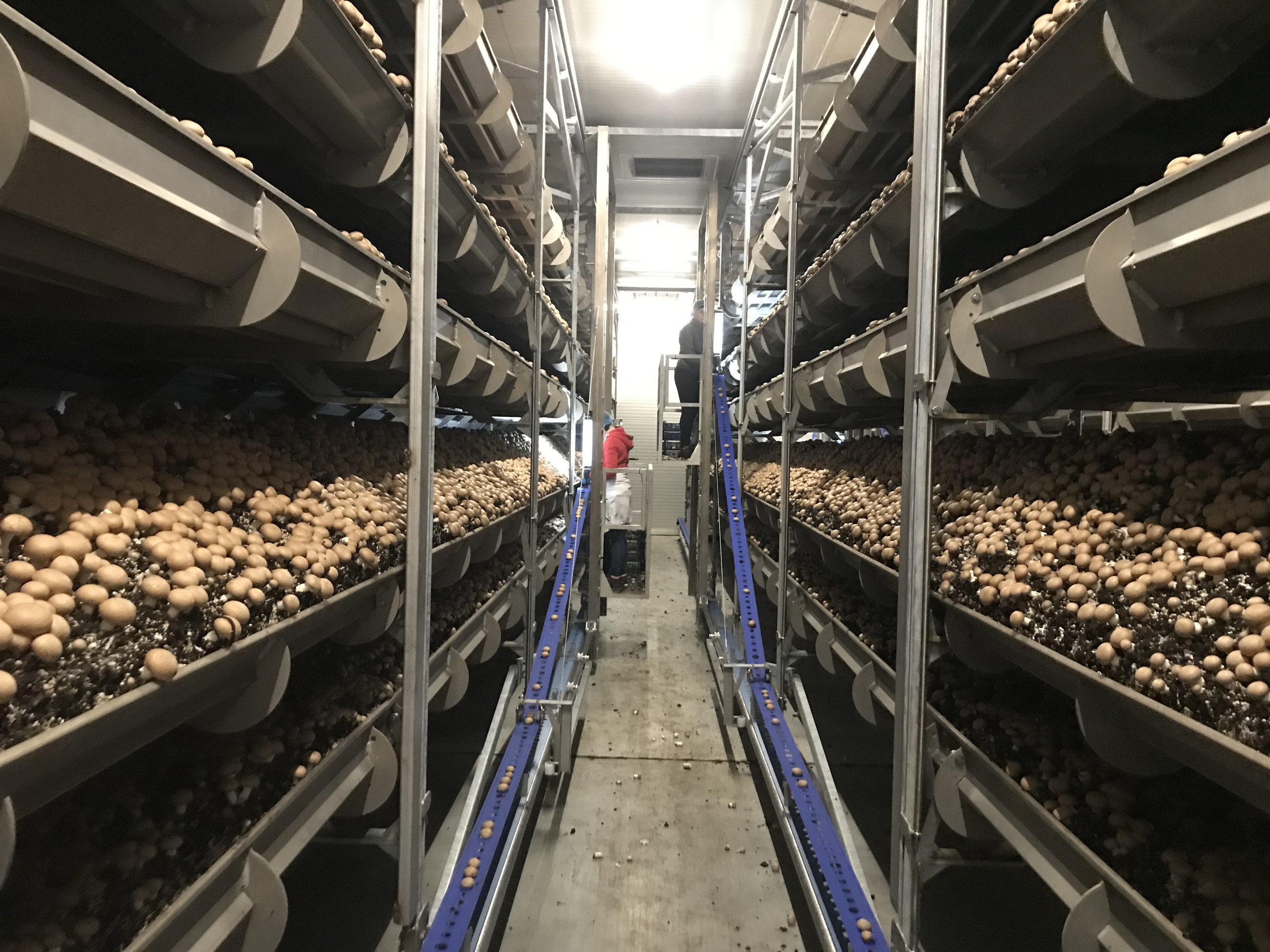
GTL Europe is now a globally recognised company involved in all levels of mushroom cultivation. It offers solutions to compost producers and farms including construction design, climate control systems, machinery, and automation solutions.
Jack Lemmen will be presenting at the 2022 AMGA conference on some of the latest developments in automation on mushroom farms. According to Jack, “The tilting shelves system was just the beginning. It is really the starting point towards a fully integrated harvesting system. Technological developments such as robotics and artificial intelligence are creating an array of opportunities to further optimise the harvesting process.”
Huge improvements have been made in scanning, grading, and packing equipment for many fresh horticultural industries. Perhaps it is time for a great leap forward for mushrooms. Jack is certainly well qualified to give insight into what new technologies are becoming available, and potential benefits for the mushroom industry. It is certain to be a fascinating subject.
This is an excerpt for the MushroomLink Spring 2022 magazine, click here to read the full article and publication

The Industry testing program: Rebooted!
Written By: Dr Jenny Ekman
TESTING TO PROVE, OR TESTING TO IMPROVE?
Among the seemingly endless list of compliance requirements that all fresh produce businesses face, verification testing is often questioned from both a cost and value perspective. “Why do we have to test” is a common question, and for most, the answer would be “because our customers say we have to”. While the answer is not wrong, the driver for compliance is misguided.
Anyone in the business of growing and supplying food to consumers understands that consumers trust the food they buy is safe and rely on the integrity of both process and product.
The seemingly endless range of testing for heavy metals, chemical residues and microbial contamination won’t itself make the product safer. However, it will provide assurance and surety that the processes followed deliver a product that is free from residues and safe to eat, factors that are critically important at a business, industry and ultimately customer level.
The Testing Program
For some years now, the Australian Mushroom Growers’ Association (AMGA) has organised competitively priced testing of fresh mushrooms and inputs (water, compost) for members. The testing commenced in the early 2000s, with the program including all the microbial, chemical residue and heavy metal tests required by food safety certification programs.
As well as providing keen pricing, the advantage of using the industry program is that all test results are reviewed and reported back accompanied by an explanation of what they mean. In other words, whether any of the results raised concerns and what should happen next if they did.
The de-identified results gathered through the program over the last 15 years are also a valuable resource for the industry as a whole. For example, from 186 tests of fresh mushrooms in the previous five years, there has been only a single detection of E. coli (which was <100 CFU/g), no detections of Salmonella spp. and no detections of Listeria monocytogenes.
Such data provides objective, defensible evidence that growers are following good practices and mushrooms are safe to eat.
Until now, the on-request testing procedure was that growers downloaded a form from the AMGA website, filled it in and sent it back to the Association. A request would then be made for a test kit to be sent to the grower from the lab. The grower took the samples, filled in the analysis request form, and returned it to the lab for testing. While this has worked well enough, it certainly added unnecessary steps in the process, an extra layer of complexity and, therefore, an opportunity for error.
Now, with the support of levy-funded project MU20000 - Extension and Adoption for Food Safety, Quality and Risk Management, every mushroom business can conduct one full suite of chemical and microbial tests each year – for FREE.
The testing on fresh mushrooms includes chemical residues (CR006), heavy metals (ESM-02) and microbial contamination (E. coli, Salmonella spp and L. monocytogenes). The program also includes a water test for E. coli (CFU/100ml).
This industry-wide service is designed to encourage verification testing to support individual businesses. It will also strengthen the pool of de-identified test data available, helping identify and manage potential risks.
The Process
Simply email your request to the Food Safety (FS) project team, and the kit will arrive in the mail accompanied by instructions, a pre-filled analysis request form and a return pre-paid satchel.
This new system also means that absolute confidentiality is ensured regarding the results. Only the FS project team will know which grower code links to which individual farm.
Again, results will be accompanied by an interpretation of what they mean. For efficiency, testing through this program will be available three times a year. The first round of free testing will commence at the start of April. The following testing rounds will be in August and December.
Email Dr Jenny Ekman to receive your FREE chemical, microbial and heavy metal test kit, helping the industry demonstrate the high standards of Australian mushrooms and providing you with the data you need for an audit.
The current testing program arrangements will continue for those businesses who need to test other inputs or test more frequently. This will now follow the new and improved administrative process.
An updated cost schedule will be available on request.
Lessons from chemical and heavy metal testing
Just like forensic investigators on TV, chemical residue or heavy metal test results can provide vital information on inputs such as compost and compost ingredients, supplements and chemicals.
When residues are detected, they are usually well below the maximum residue level (MRL). However, when there are detections, it is worth considering at what percentage of the MRL they are and reviewing factors such as inputs, use patterns and application rates. this approach ensures total control of products and processes, in the most cost-effective way.
Lessons from microbial testing
Close monitoring of microbial test results can often pre-empt an issue before it becomes a problem. Indicator organisms detected at low levels in products or inputs can help identify issues with infrastructure, cleaning and hygiene practices.
A problem understood is a problem solved, and testing produces the opportunity for this understanding
This article was originally published in the 1st issue 2022 edition of the Australian Mushrooms Journal

Reset and Refresh – towards better collaboration between Hort Innovation and industry
In mid-last year, the Seftons review was commissioned to examine the working relationships between industry peak industry bodies (PIBs) and Hort Innovation. The review identified a number of issues, particularly relating to governance and communication.
As a result, a working group was established consisting of representatives from the PIBs, the Hort Innovation board and the Commonwealth government. The working group has been developing a new framework for collaboration between industry and HIA.
On 14 and 15 June mushroom industry representatives Geoff Martin, Nick Femia and Leah Bramich took part in two “Reset and Refresh – Roles, responsibilities and advice mechanisms” industry workshops. The aim was to find ways to work together better, particularly in terms of developing advice mechanisms for both research and development and marketing and promotion.
Discussion was constructive and focussed on raising the quality of outcomes for all industry participants. Hort Innovation has committed to communicating clearly and regularly with industry and is currently considering how best to act based on industry feedback. The outcome should be maximised returns on investment for all levy payers.
According to AMGA General Manager Leah Bramich “This was an extremely important and positive first meeting, with Hort Innovation and industry working together collaboratively and transparently. I am really pleased to see this important first step towards meaningful change and a better future”.
Access the HIA report on this initiative or download the DAWE Best Practice Guide to Stakeholder Consultation.