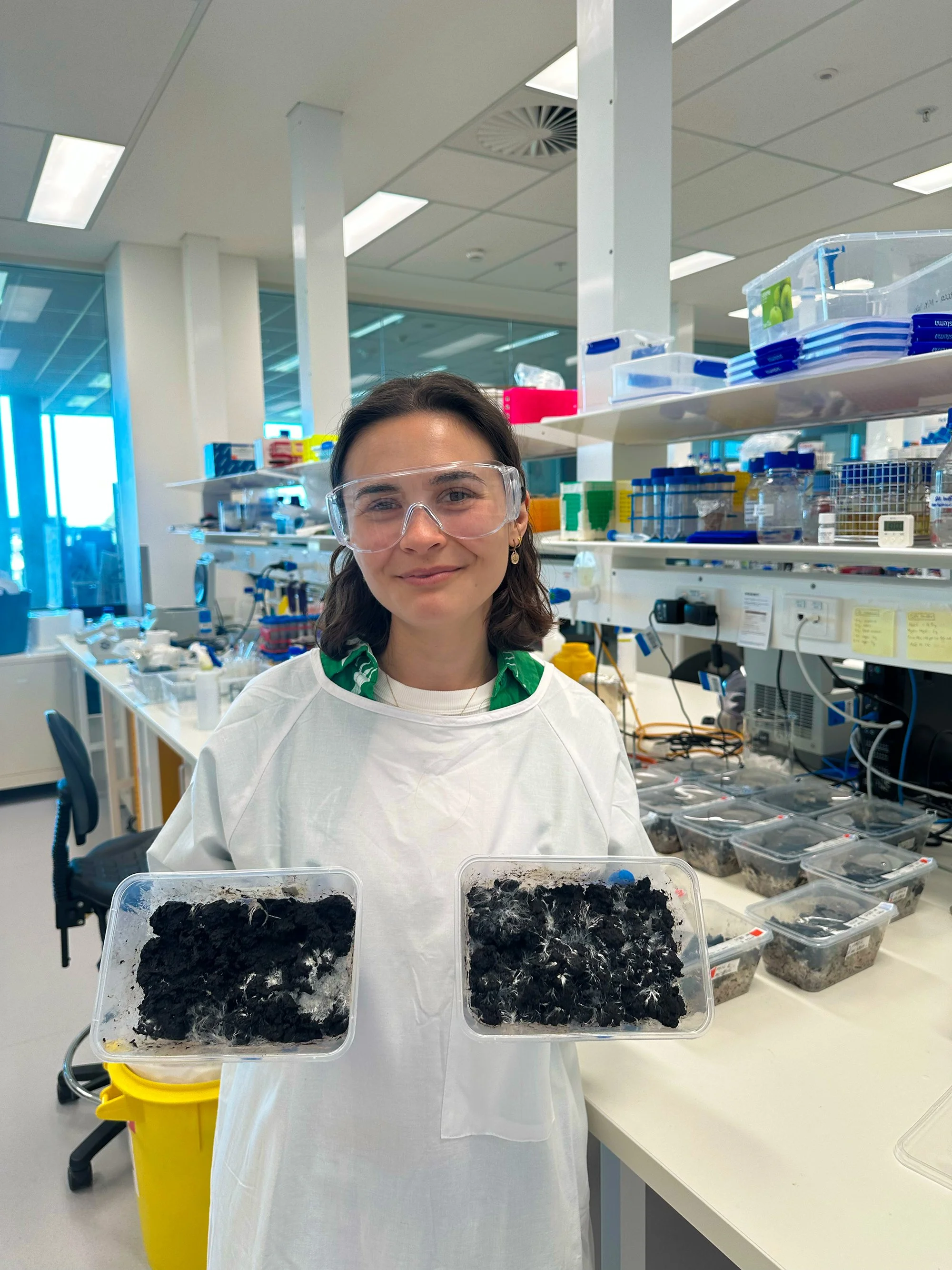
Identifying bacteriophages in mushroom compost
Bacteriophages may not be alive, but they are the most abundant biological agents on earth.
Bacteriophages are viruses that attack bacteria. The classic image of a bacteriophage looks a bit like a lunar landing module, with a capsid 'head' containing genetic material, collar and sheath, and a set of “legs” that attach to the bacterium’s surface. These (larger) phages have double stranded DNA genomes. However, others are simply a single, filamentous strand of coated DNA or RNA, or a tiny capsule.
Despite their abundance, bacteriophages are little studied. This is most likely because it is very difficult!
University of Sydney PhD candidate Rebecca Martin has taken on the considerable challenge of isolating and identifying bacteriophages present in mushroom compost.