
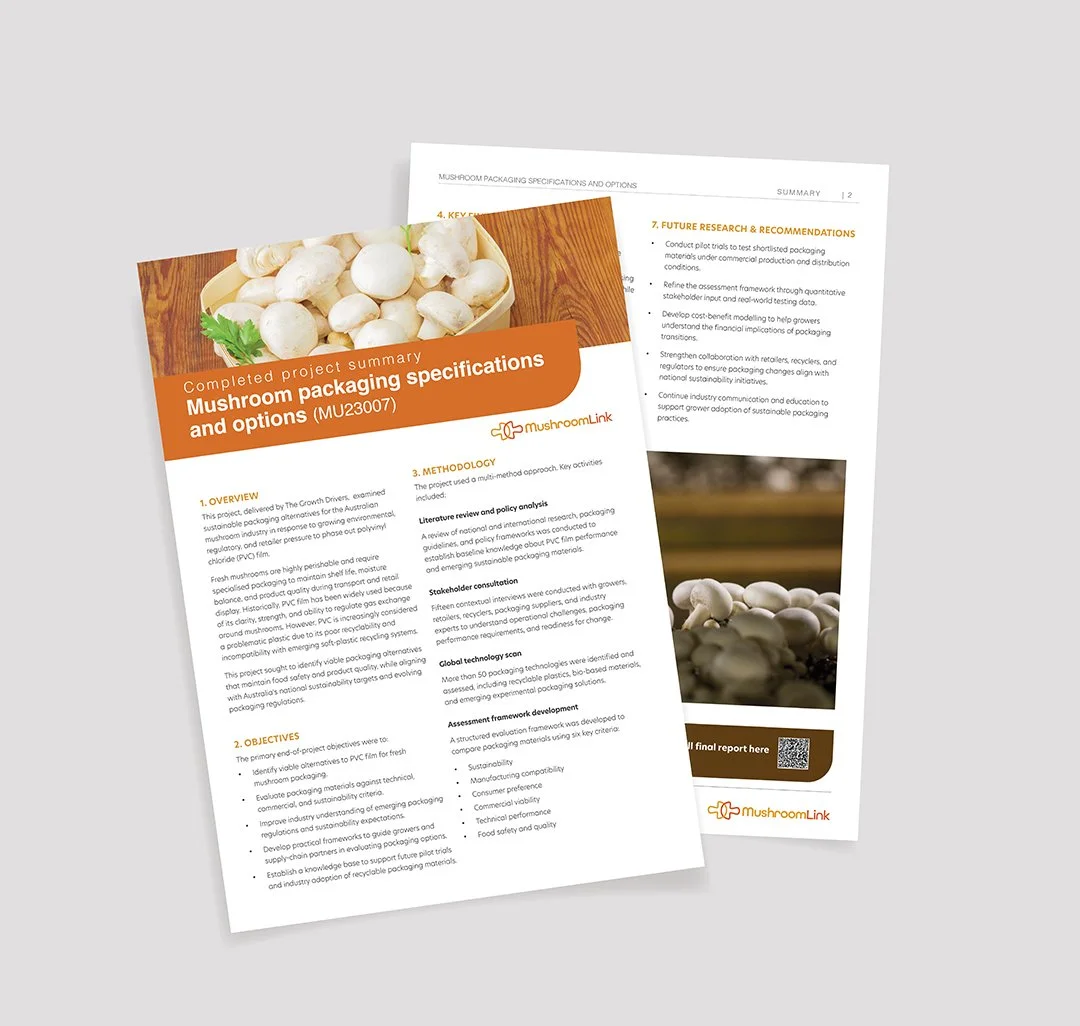
Final report summary - Mushroom packaging specifications and options (MU23007)
The project MU23007: Sustainable Packaging Alternatives for Australian Mushrooms (2019–2021) was a strategic industry initiative delivered by The Growth Drivers and funded by Hort Innovation. It responded to increasing environmental, regulatory, and retailer pressure to transition away from polyvinyl chloride (PVC) film, supporting broader industry sustainability objectives.
The project focused on identifying and evaluating viable packaging alternatives for fresh Australian mushrooms (Agaricus bisporus), aiming to maintain product quality, shelf life, and food safety while aligning with evolving national packaging regulations and sustainability targets.
The summary also includes a link to the full final report.
When the question changes: Why the ethylene project has pivoted
Research does not always end where it begins. Occasionally, the most useful outcome is discovering that the original question was not quite the right one.
This has been the case with project MU24002 - Improving mushroom supply chain handling and packaging to reduce quality loss, which originally set out to investigate whether exposure to ethylene gas contributes to quality loss in fresh mushrooms as they move through the domestic supply chain.
However, the results were clear: Mushrooms were not sensitive to ethylene under the conditions tested. Even relatively high ethylene concentrations, up to 5 ppm (parts per million), did not produce browning or the types of deterioration normally associated with loss of quality.
Carbon dioxide seemed to be a greater problem.
When things go wrong - Practical steps for mushroom growers
About this webinar
In this webinar, food safety and postharvest experts Melisa Cavallaro and Dr Jenny Ekman explore what happens when things go wrong in farm and how to respond effectively. This session will help you to strengthen your team’s readiness and refine your response systems.
Melisa steps through the corrective action framework, outlining what to do in the event of contamination. From containment and investigation to escalation and documentation, the framework provides a clear, structured approach to managing incidents while maintaining confidence and leadership.
Jenny draws on years of industry experience with pathogens and walks us through how they’re detected, what test results really mean, and why the presence of bacteria doesn’t always signal a food safety crisis.
Through practical scenarios - including microbial, chemical, and physical contamination events, this session will help you understand how to apply the framework in real-world situations.
This webinar is part of Food Safety Month, an initiative of the Hort Innovation mushroom levy-funded project 'Extension and adoption for food safety, quality and risk management (MU20000)', led by the Australian Mushroom Growers' Association.
About the presenters
Dr Jenny Ekman (AHR)
Dr Ekman is a postharvest physiologist and communicator who works to maximise produce freshness and value while minimising supply chain losses. She is passionate about applying science to improve commercial and consumer outcomes.
Melisa Cavallaro
Melisa Cavallaro is a certified HACCP Practitioner with over 15 years’ experience in food safety consulting, specialising in fresh produce. She is passionate about safe guarding the Australian agricultural industry and is dedicated to bridging the gap between GFSI certifications and small family-operated farms.
Future of mushroom packaging
Join us for an important update on the future of mushroom packaging.
In this webinar on the 21 August, Roberto Persivale from The Growth Drivers shared insights from a national project investigating alternatives to PVC film, with a strong focus on the shifting regulatory landscape and its implications for stakeholders (including growers). New developments, including the proposed SPSA (Soft Plastics Stewardship Australia) levy and emerging EPR (Extended Producer Responsibility) frameworks, signal a fundamental change in how packaging decisions will be made and who bears the cost.
In parallel, the project has scoped potential alternatives and developed a flexible assessment framework that reflects the real-world needs of different producers. The next stage of the project will focus on refining and quantifying this framework—defining baselines for technical, economic, and sustainability criteria that will guide the development of trial roadmaps and support cost-benefit assessments across the industry.
This session is your opportunity to stay ahead of what’s coming and help shape a solution that works for your business and the broader mushroom sector.
The future of mushroom packaging
As consumers and regulators become increasingly concerned about sustainability, the Australian mushroom industry needs to explore alternative packaging solutions to meet the growing demand for environmentally friendly products. With fewer than 50 commercial growers, the mushroom industry has the opportunity to adopt sustainable packaging solutions across the board, positioning itself as a leader in Australian horticulture.